The Architecture of Arrival
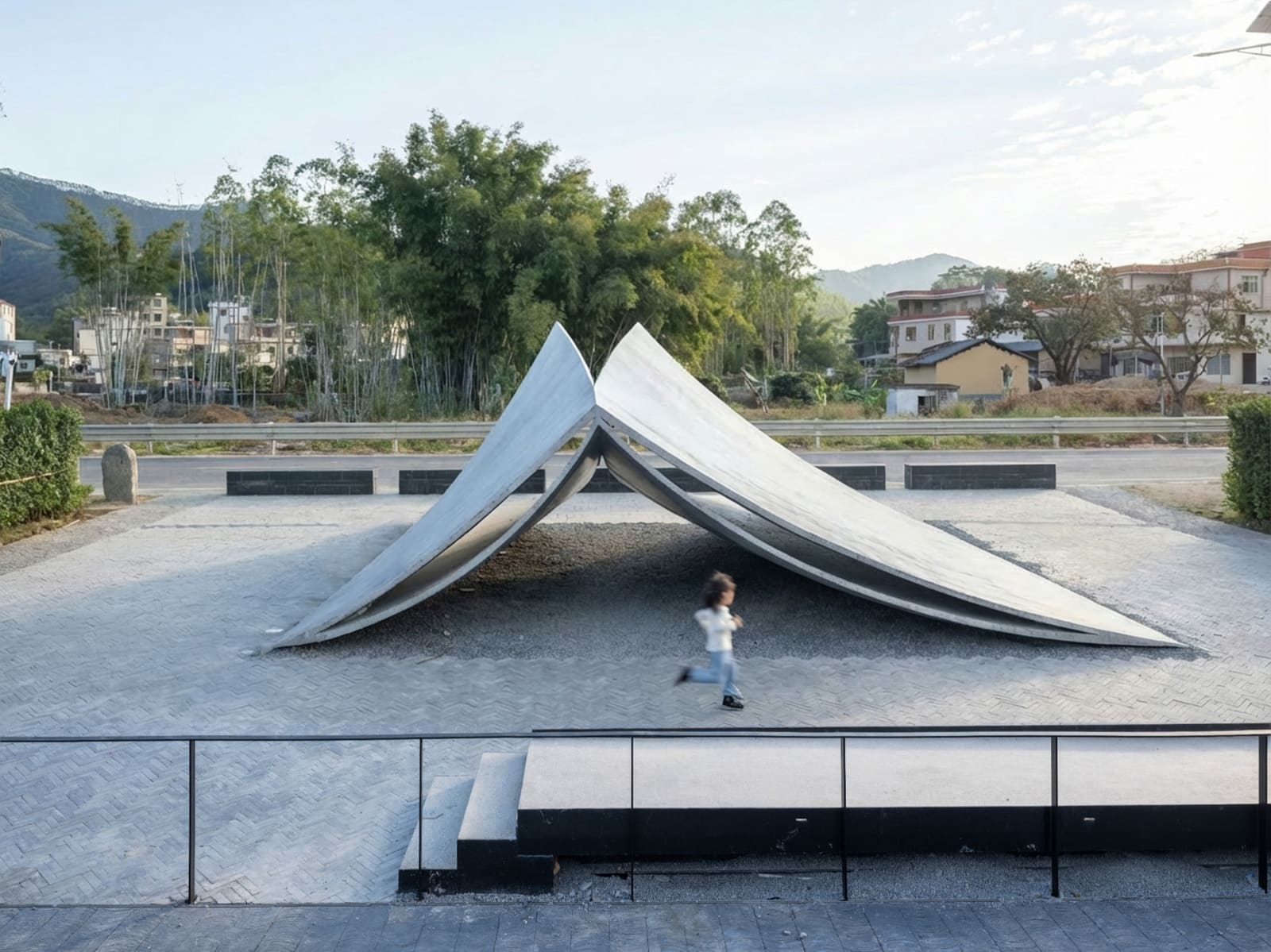
We tend to think of buildings as destinations, yet some of the most compelling work in contemporary practice operates in the space before arrival. At World Archi Design, we've been tracking a shift toward installations that function less as objects and more as atmospheric conditions, structures that modulate perception rather than simply occupy ground. Pages Afloat, a compact intervention by Shenzhen-based f-a-n architects, exemplifies this approach. Sited on the riverbank at the entry to Huizhou's Village of Letters in Guangdong Province, the structure spans just 61 square meters but carries the weight of introducing visitors to a landscape steeped in literary heritage.
The installation sits in dialogue with a millennium-old banyan tree on the opposite bank. That relationship, tree to structure across water, establishes the project's fundamental tension: between the enduring and the ephemeral, the organic and the constructed. Where the banyan spreads its canopy as a marker of deep time, Pages Afloat operates as a contemporary counterpoint, a deliberate frame through which the village's narrative begins to unfold.
Threshold as Tectonic Strategy
f-a-n architects, working with structural engineer iStructure, has conceived the installation not as shelter but as passage. The term "threshold" appears frequently in architectural discourse, often deployed loosely to describe any transitional space. Here, it takes on material specificity. The structure functions as a spatial hinge, mediating between the arrival sequence and the village proper, between the quotidian experience of approach and the heightened awareness the site demands.
This is threshold-making in the tectonic sense: a constructed interval that does not simply separate but activates the movement between conditions. Design team members Ziyue Liu, Shuai Wang, and Wanying Xie have calibrated the installation's scale and positioning to resist monumentality while asserting presence. At 61 square meters, the footprint is modest, yet its placement along the water's edge amplifies its role within the larger choreography of arrival.
The project's name, Pages Afloat, suggests both lightness and fluidity. One reads it as a metaphor for the literary traditions embedded in the village's identity, but also as a description of formal strategy. The installation appears to hover above the riverbank, its structure dematerialized through careful detailing. This is not the heavy-handed symbolism of a book-shaped pavilion or a literal interpretation of "pages." Instead, the architects have abstracted the concept into spatial rhythm, into the play of solid and void, opacity and transparency.
Materiality and the Riverine Context
Sited along a river, the installation must negotiate both visual and environmental conditions unique to waterfront locations. Humidity, seasonal flooding, reflection, and the movement of light across water all impose constraints that shape material choices and assembly logic. While specific material specifications are not detailed, the photographs by Fangfang Tian and Jinquan Kong reveal a structure that privileges lightness and permeability.
The installation's relationship to the water is not incidental. Rivers in Chinese landscape tradition function as narrative devices, pathways that structure movement and frame views. By positioning Pages Afloat at the water's edge, f-a-n architects aligns the project with this lineage, invoking the classical garden technique of borrowed scenery while grounding the intervention in a contemporary spatial vocabulary.
One might draw a comparison to the pavilion typology explored by Wang Shu in his early work, where small-scale structures serve as instruments for reading landscape. Yet where Wang Shu often employed salvaged materials and vernacular construction methods to embed his pavilions in local memory, f-a-n architects pursues a more distilled aesthetic. The result is less about material nostalgia and more about perceptual clarity, a deliberate reduction that foregrounds the act of crossing from one experiential zone to another.
Village of Letters as Cultural Landscape
Huizhou Village of Letters carries a name that immediately signals its identity. The village's association with literary culture, whether through historical figures, scholarly traditions, or preserved texts, provides the conceptual armature for Pages Afloat. Yet the installation does not illustrate this heritage so much as it inaugurates an encounter with it. The structure becomes the first gesture in a spatial narrative that unfolds as visitors move deeper into the village.
This approach reflects a broader trend in Chinese architectural practice: the use of small-scale interventions to revitalize rural landscapes without resorting to pastiche or wholesale reconstruction. Projects like Xu Tiantian's rural renovations in Songyang County or the work of DnA_Design and Architecture in Zhejiang demonstrate how carefully calibrated additions can reframe existing conditions, making visible what might otherwise remain overlooked. Pages Afloat operates in this vein, offering a contemporary lens through which the village's layered history can be apprehended.
The installation's completion in 2025 positions it within a moment of intensified attention to China's rural territories. As urbanization pressures persist, designers and policymakers alike have turned to village revitalization as both cultural project and economic strategy. The challenge lies in avoiding the twin pitfalls of commodification and stagnation. Pages Afloat suggests a middle path: an intervention that respects the site's existing character while introducing a new spatial logic, one that invites slowness and attention.
Across the Water: The Banyan as Counterpoint
The thousand-year-old banyan tree across the river is more than scenic backdrop. In the project's spatial composition, the tree functions as anchor and counterweight. Banyans, with their aerial roots and expansive crowns, carry deep symbolic resonance in South China. They mark gathering places, provide shade in village squares, and embody continuity across generations. By siting the installation in direct visual relationship to the banyan, f-a-n architects establishes a dialogue between human-made and natural form, between the precision of architectural intervention and the organic growth patterns of the tree.
This pairing also sets up a pedagogical moment. Visitors arriving at the village encounter first the installation, a constructed threshold that orients them toward the landscape. Looking through or beyond the structure, they register the banyan, an element of the landscape that predates the village itself. The sequence trains the eye to move between scales and temporalities, preparing visitors for the layered experience the village offers.
In this sense, Pages Afloat functions as a didactic device, though not in the heavy-handed manner of signage or interpretive text. The installation teaches through spatial experience, through the calibrated relationship between built form and natural setting. It asks visitors to pause, to register the threshold they are crossing, and to acknowledge the shift from arrival to immersion.
Scale, Ritual, and the Politics of Entry
At 61 square meters, the installation operates at a scale closer to furniture than building. This compression is strategic. The structure cannot accommodate large groups; it forces a measured, almost ritualized passage. In a cultural context where thresholds have long carried ceremonial weight, from the spirit walls of courtyard houses to the moon gates of classical gardens, Pages Afloat participates in a tradition of marking entry as a moment of transformation.
Yet the installation also reflects contemporary concerns. In an era of mass tourism and rapid consumption of place, the project's insistence on slowness and deliberation reads as a form of resistance. By refusing to be merely photogenic backdrop, Pages Afloat asserts architecture's capacity to shape behavior, to modulate the pace and quality of engagement with a site. This is not architecture as spectacle but as protocol, a set of spatial instructions that visitors must negotiate.
The collaboration with iStructure, the project's engineering consultants, suggests attention to structural performance that belies the installation's apparent simplicity. Achieving the sense of lightness evident in the photographs requires precise calculation, particularly in a riverine environment subject to wind loads and potential flooding. The engineering becomes invisible, subordinated to the spatial and perceptual goals of the project, yet it is this technical rigor that enables the installation's formal clarity.
Forward: Installation as Index
Pages Afloat joins a growing body of work that uses small-scale architectural interventions to index larger cultural and environmental conditions. These projects, often temporary or semi-permanent, function as probes, testing how design can mediate between visitors and place, between contemporary spatial practices and inherited landscapes. As rural revitalization efforts continue across China, the question of how to introduce new layers without erasing existing ones becomes increasingly urgent.
f-a-n architects' installation offers one answer: build small, build precisely, and build in dialogue with what already exists. The structure does not attempt to compete with the banyan or overshadow the village. Instead, it marks the threshold with sufficient clarity to make the act of entry legible, to transform arrival into an event worth noticing. In doing so, Pages Afloat reminds us that architecture need not be large to be significant, that a 61-square-meter intervention on a riverbank can carry as much conceptual weight as a tower or museum, provided it is positioned and calibrated with care.
Photo: Fangfang Tian
Save this story. A free account keeps your reading list and the 07:00 email in one place.
CREATE FREE ACCOUNT →SIGN IN