The Limits of the Green Prescription
For the past two decades, urban forestry has enjoyed near-universal support among planners, policymakers, and architects. The benefits are tangible: mature trees lower ambient temperatures through evapotranspiration, sequester carbon, absorb stormwater, and provide measurable improvements to mental health. On a scorching afternoon, the difference between a tree-lined boulevard and an exposed plaza can be as much as eight or ten degrees Celsius.
Yet as we've covered projects across climates and geographies, a pattern has emerged. Cities facing the most acute heat stress are often the least able to implement large-scale tree planting. The challenge is not ideological but infrastructural. A sapling planted today will require a decade or more to cast meaningful shade, and in the interim, it demands water, root volume, and soil health that many dense urban fabrics cannot provide. In arid regions, the water footprint of maintaining a healthy canopy competes with residential and agricultural needs. In older cities, underground utilities, shallow soil, and compacted substrates leave little room for root systems. And everywhere, the long-term costs of pruning, pest control, storm response, and pavement repair strain municipal budgets already stretched thin.
The absence of trees in certain urban districts is not always a failure of policy. It is often a reflection of geology, hydrology, and economic reality.
Material Strategies for Immediate Relief
Where biological solutions are impractical or too slow, architects and urban designers are turning to material interventions that provide instant thermal relief. Tensile fabric structures, for instance, have become a staple of public space design in the Middle East and parts of Australia. Lightweight, UV-resistant textiles stretched over steel or timber frames create expansive zones of shade with minimal footprint and no need for irrigation. The tectonic language is straightforward: tension, anchor points, and a membrane that filters light without trapping heat below.
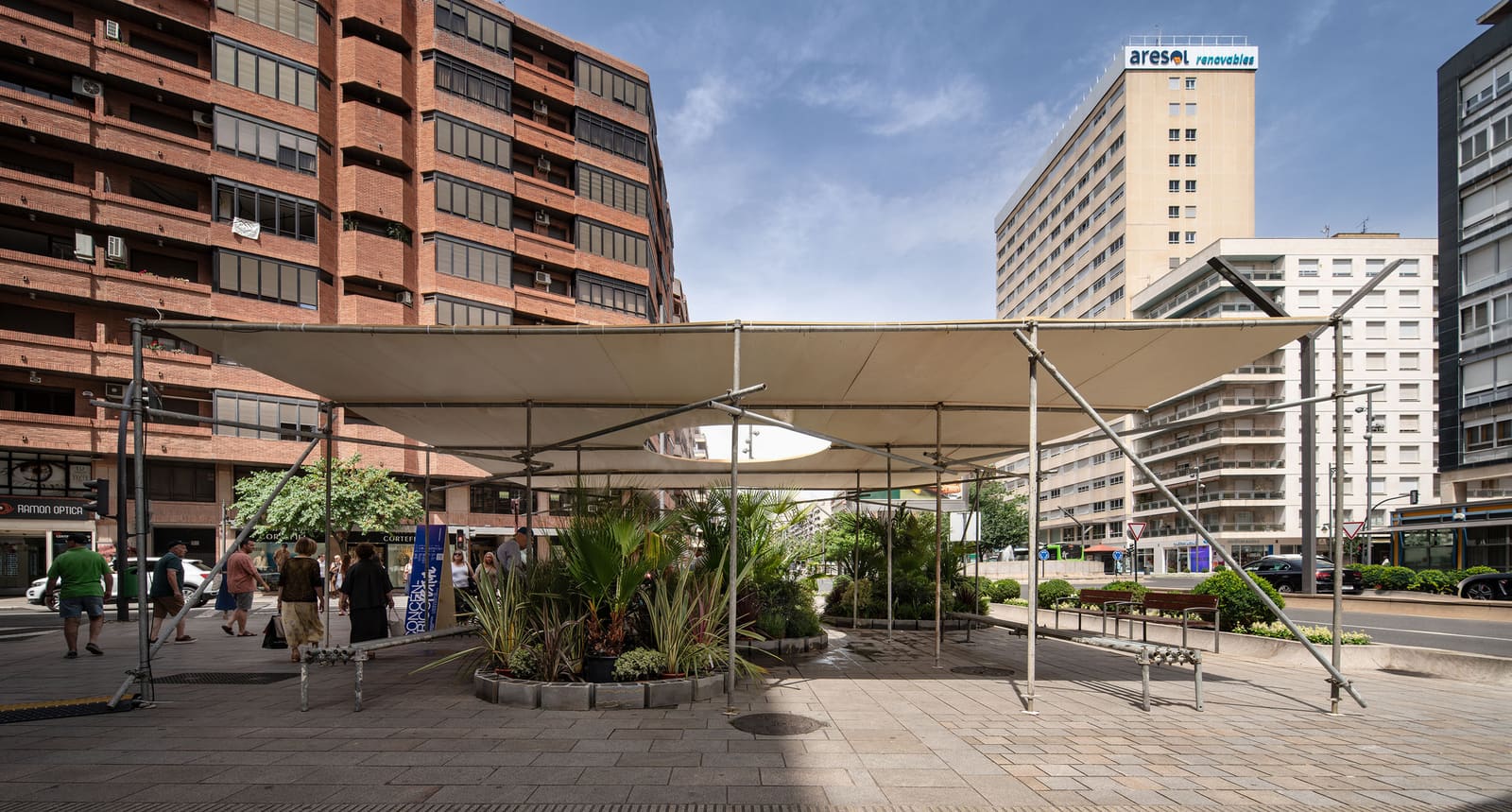
In Logroño, Spain, NOOF Group's installation at the Concéntrico festival demonstrated how passive cooling can be achieved through layered canopies that channel airflow while blocking direct solar gain. The structure relied on geometry rather than greenery, using perforated panels and strategic orientation to induce convective breezes. The result was a microclimate that felt several degrees cooler than adjacent streets, achieved without a single liter of irrigation water.
Perforated metal and timber lattices offer a middle ground between full shade and dappled light. These systems, often modular and prefabricated, can be deployed rapidly and adapted to irregular sites. They also allow for future integration with climbing plants, should water availability improve, creating a hybrid typology that is both immediate and evolutive.
Adaptive Reuse of Existing Infrastructure
Another emerging strategy involves repurposing existing urban infrastructure to provide shade. Elevated highway underpasses, railway viaducts, and parking structures, traditionally seen as dead zones, are being reimagined as shaded public spaces. In cities like Melbourne and Singapore, these liminal areas have been equipped with seating, lighting, and ventilation to transform them into refuges from midday heat.
This approach leverages sunk costs. The structure already exists; the intervention is one of programming and minor modification rather than wholesale construction. It also sidesteps the slow timeline of tree maturation. A shaded underpass can be activated in months, not years.
The design challenge lies in addressing the sensory qualities of these spaces, which can feel oppressive or unsafe without careful attention to lighting, sightlines, and acoustic treatment. But when executed well, the strategy offers a pragmatic response to heat stress in environments where surface-level planting is constrained by utilities, traffic, or soil conditions.
Reflective Surfaces and Urban Albedo
Increasing the reflectivity of urban surfaces is another tool in the thermal mitigation toolkit. Cool pavements, made from light-colored aggregates or coated with high-albedo finishes, reduce heat absorption and lower surface temperatures by reflecting rather than storing solar radiation. Los Angeles has deployed cool pavement coatings across several neighborhoods, reporting measurable reductions in street-level temperatures.
The strategy is not without trade-offs. Highly reflective surfaces can create glare, discomfort, and even increase heat stress for pedestrians if poorly oriented. The key is calibration: selecting materials with appropriate reflectance values and pairing them with shade structures or vegetation to mitigate direct exposure.
White or light-colored roofs, a related intervention, reduce cooling loads on buildings and lower the urban heat island effect at the neighborhood scale. While not a public-space solution per se, the cumulative impact of reflective roofing across a dense district can be significant, particularly in cities with low-rise, flat-roof typologies.
Water as Ephemeral Shade
Water features, from misting systems to shallow splash pads, provide evaporative cooling without the long-term commitment of irrigation infrastructure for trees. These installations are particularly effective in arid climates, where even small amounts of water introduced into the air can produce disproportionate thermal relief.
Misting systems, often integrated into pergolas or public seating areas, lower ambient temperatures through direct evaporation. The effect is localized and temporary, but the infrastructure is simple and can be activated on-demand during heat events. In Dubai and Phoenix, misting has become a standard feature of outdoor dining and transit waiting areas.
Splash pads and interactive water features serve a dual function: they cool the immediate environment and draw people into public space, creating social infrastructure alongside thermal relief. The challenge, again, is water availability. In regions facing chronic drought, even these modest uses must be weighed against competing demands.
Policy and the Question of Equity
The turn toward non-botanical shade strategies raises important questions about equity and access. Tree planting has long been framed as a climate justice issue, with low-income neighborhoods disproportionately lacking canopy cover. If cities begin to prioritize built shade over green infrastructure, there is a risk that wealthier districts retain their trees while under-resourced areas receive only structural interventions.
The answer is not to reject built shade but to deploy it strategically, as a complement rather than a replacement. In neighborhoods where soil conditions, water access, or maintenance capacity make tree planting difficult, tensile structures, reflective pavements, and repurposed infrastructure can provide immediate relief while longer-term greening strategies are developed. The goal is thermal equity, not aesthetic uniformity.
At World Archi Design, we have observed that the most successful heat mitigation projects are those that combine multiple strategies: a tensile canopy paired with native, drought-tolerant plantings; a cool pavement system integrated with misting stations; an underpass activation that includes greenery in planters rather than in-ground. The hybrid approach acknowledges that no single intervention is sufficient, and that context, always, determines form.
Looking Forward
The cities that will thrive in a warmer future are those that adopt a pluralistic approach to shade, one that values trees where they can flourish but does not depend on them exclusively. This requires a shift in how we evaluate urban greening initiatives, moving beyond canopy coverage as the sole metric of success and toward a more nuanced assessment of thermal comfort, resource efficiency, and adaptability.
It also demands a willingness to experiment with materials, typologies, and spatial configurations that may not carry the same cultural cachet as a mature tree-lined street but that deliver measurable improvements in livability. The challenge for architects and urban designers is to make these interventions not merely functional but beautiful, to craft shade structures that become beloved landmarks in their own right, and to recognize that thermal relief, in whatever form it takes, is an essential dimension of the public realm.
Photo: Josema Cutillas
Save this story. A free account keeps your reading list and the 07:00 email in one place.
CREATE FREE ACCOUNT →SIGN IN