A New Chapter for Forgotten Landmarks
Architecture, like all cultural production, is selective in its memory. Some buildings are celebrated, catalogued, and preserved; others slip quietly into disrepair, their stories erased before anyone thinks to record them. For structures designed by Black architects, this erasure has been systematic. The modernist work of practitioners who shaped American cities throughout the mid-20th century often goes unrecognized, overshadowed by a canon that has historically centered white, European narratives.
A Milwaukee shopping center, once a thriving hub for Black-owned businesses, sat on the edge of demolition. A university building in Houston that honors a civil rights icon faced uncertain maintenance. A church in Indiana, its roof folded like origami to evoke praying hands, struggled to fund basic repairs. These are not marginal footnotes in architectural history; they are central documents of American design, embodying innovation, community resilience, and spatial ambition. Yet until recently, they lacked the institutional support that might secure their survival.
The Getty Foundation, in partnership with The National Trust for Historic Preservation, has awarded preservation grants totaling $150,000 each to five such sites through its Conserving Black Modernism initiative. Launched in 2022, the program has now distributed more than $4.85 million across the United States, targeting modern structures integral to Black history that face neglect or demolition. This year's recipients span geographies and typologies, from educational buildings on HBCU campuses to public infrastructure born from activist movements. Together, they represent a deliberate effort to expand what counts as worthy of preservation and who gets to write architectural history.
The Shopping Center That Defined a Neighborhood
In 1973, Alonzo Robinson Jr. completed a shopping complex in Milwaukee that became a social anchor for the city's Black community. Robinson, Wisconsin's first licensed Black architect, designed the three-building campus in the New Formalist style, a mode characterized by sweeping porticos, arcades, and a sense of monumental optimism. The complex housed a bowling alley, law offices, and a restaurant serving both soul food and French cuisine, a culinary range that reflected the aspirations and diversity of its patrons.
New Formalism was an unusual choice for Milwaukee, a city more accustomed to the industrial vernacular of brick and steel. Robinson's decision to employ concrete panels and dramatic wings signaled something different: a belief that Black commercial life deserved architectural grandeur. The plaza was not merely functional; it was a statement about visibility and permanence.
Over the decades, economic shifts and disinvestment hollowed out the complex. The Salvation Army took over several structures in the early 1980s, converting them into a homeless shelter. Public awareness campaigns managed to halt the demolition of one building, but the campus's future remained precarious. The Getty grant will fund a strategic report to guide restoration and enable the Salvation Army to expand its services, preserving Robinson's vision while adapting it to contemporary needs.
A University Building That Honors a Legacy
On the campus of Texas Southern University, an HBCU in Houston, stands a building completed in 1969 by John Saunders Chase Jr., just one year after the assassination of Dr. Martin Luther King Jr. The structure, now home to the School of Communications, features a sweeping roof and a central volume composed of stacked discs, a form that recalls King's layered legacy of activism, scholarship, and moral clarity.
Chase went on to co-found the National Organization of Minority Architects, an advocacy group that has worked for decades to address inequities in the profession. His design for the King Humanities Center embodies the educational and political aspirations of its era, a moment when HBCUs were both training grounds for Black intellectuals and sites of resistance against segregation.
The grant will support a comprehensive report identifying preservation priorities and documenting the building's history. For a university that serves as a living archive of Black achievement, the project is more than maintenance; it is an act of institutional memory.
The Oldest Black-Owned Firm and an HBCU Campus
McKissack & McKissack, the oldest Black-owned architecture firm in the United States, has a history that stretches back to the 19th century. In 1954, Moses McKissack III designed a campus building for Fisk University in Nashville, another HBCU with deep roots in Black intellectual life. The three-story structure, clad in red brick and defined by modernist proportions, contains classrooms, administrative offices, and a lecture hall.
The design is restrained, eschewing ornament in favor of clarity and function. Yet its modesty should not be mistaken for lack of ambition. McKissack was working within a tradition of Black educational architecture that prioritized dignity, permanence, and the creation of spaces where Black students could learn free from the hostility of segregated society.
The preservation grant will help develop a management plan for the building and document McKissack & McKissack's broader contributions to the Fisk campus. The firm's work, spread across multiple institutions, represents a continuous thread of Black architectural practice that has shaped the built environment of the American South.
Public Space Born from Protest
In Boston, a four-mile corridor now occupied by a public train line and 52 acres of parkland exists because activists successfully halted the construction of a 12-lane highway in the 1960s. The proposed road would have bisected neighborhoods, displacing residents and severing communities. The protest movement, rooted in environmental justice and urban equity, forced a rethinking of infrastructure planning.
The Massachusetts Bay Transportation Authority eventually built the Southwest Corridor, a public transit and park system designed by Stull & Lee, Inc., a Black-led architecture firm based in Boston. The most notable element is Ruggles Station, a postmodern structure that integrates transit, pedestrian movement, and landscape into a single cohesive gesture.
The Getty funds will support documentation of the site through 3D modeling, photography, and archival research. The project is a reminder that preservation is not only about individual buildings but also about the larger systems and social movements that shape urban form.
A Church That Prays in Three Dimensions
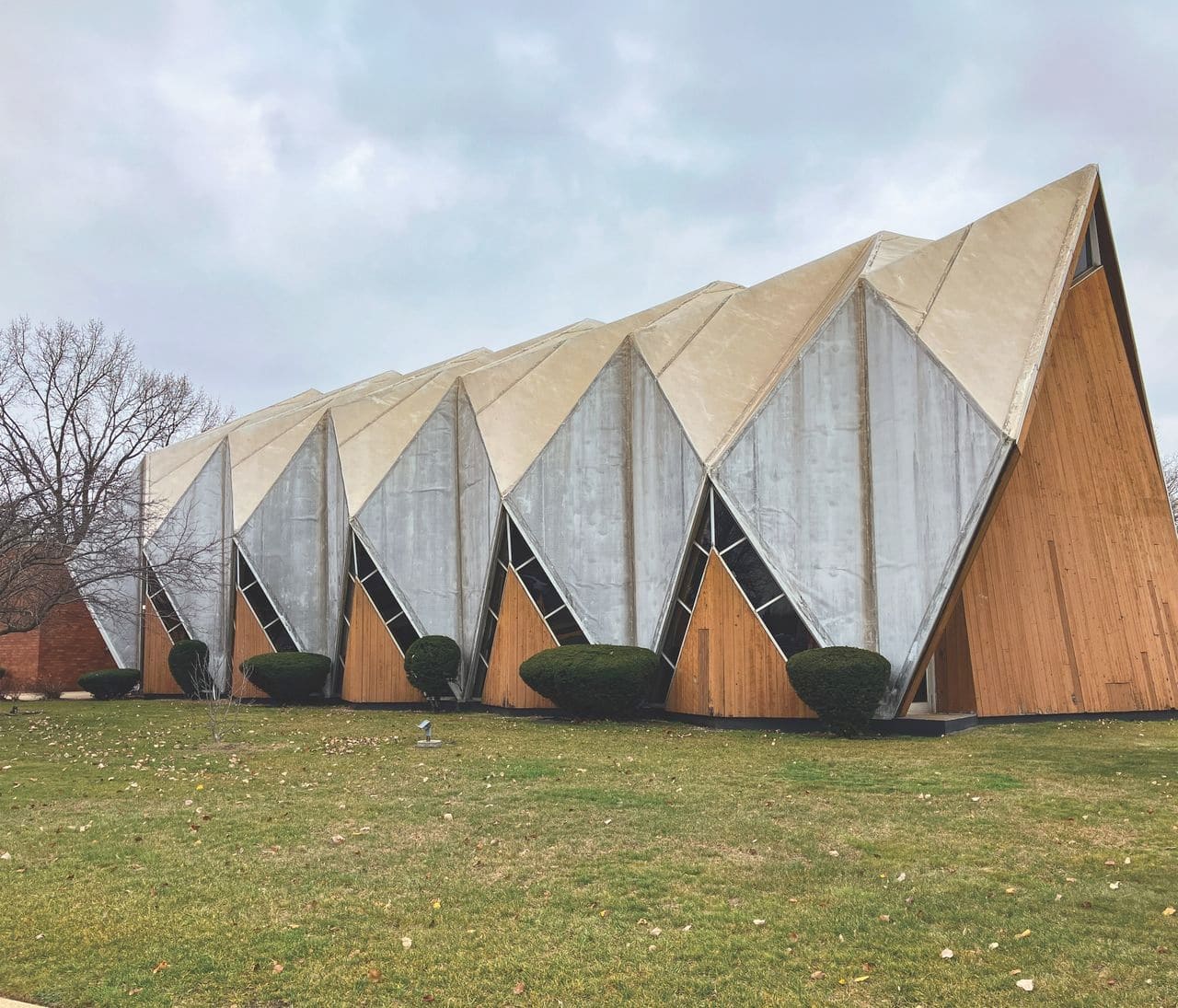
In East Chicago, Indiana, a church designed by Wendell Campbell rises from the flat Midwestern landscape like a folded piece of paper. Completed in the late 20th century, the structure's roof folds upward to evoke praying hands, a literal translation of spiritual aspiration into built form. Campbell, like Chase, was a founding member of the National Organization of Minority Architects, and his work reflects a commitment to architecture as both craft and social practice.
The church features triangular ribbon windows that admit light in shifting patterns throughout the day, and a sanctuary free of interior columns, creating an uninterrupted volume for worship. The origami-like roof is structurally daring, a tectonic experiment that doubles as a symbol.
The grant will enable the congregation to create a preservation plan addressing ongoing maintenance and rehabilitation needs. For a building that serves both functional and symbolic roles, the funding is essential to ensuring that future generations can experience Campbell's synthesis of form and faith.
Redefining What Deserves to Endure
Joan Weinstein, director of the Getty Foundation, noted that Conserving Black Modernism has helped broaden the definition of modernist architecture itself. The program challenges the assumption that modernism is a singular, European-derived movement, revealing instead a multiplicity of practices shaped by race, region, and resistance.
The National Trust's African American Cultural Heritage Action Fund has distributed an additional $2.26 million to 22 other sites across the country, including a seed barn in rural Alabama that will house the Emmett Till Interpretive Center and barracks in Arizona that once housed the Buffalo Soldiers. These projects underscore the geographic and typological diversity of Black architectural heritage, from rural vernacular structures to urban monuments.
Preservation, in this context, is not a nostalgic exercise. It is a political act, a refusal to let erasure stand unchallenged. The buildings recognized by Conserving Black Modernism are not merely artifacts; they are active participants in ongoing conversations about who belongs in the city, what kinds of spaces are deemed worthy of care, and whose histories are allowed to shape the future. At World Archi Design, we've seen how preservation funding can catalyze not only physical restoration but also renewed community engagement and historical scholarship. These five projects, scattered across the United States, are now equipped to do both.
Photo: Blake Swihart / Indiana Landmarks
Save this story. A free account keeps your reading list and the 07:00 email in one place.
CREATE FREE ACCOUNT →SIGN IN