A Morphology Against the Grain
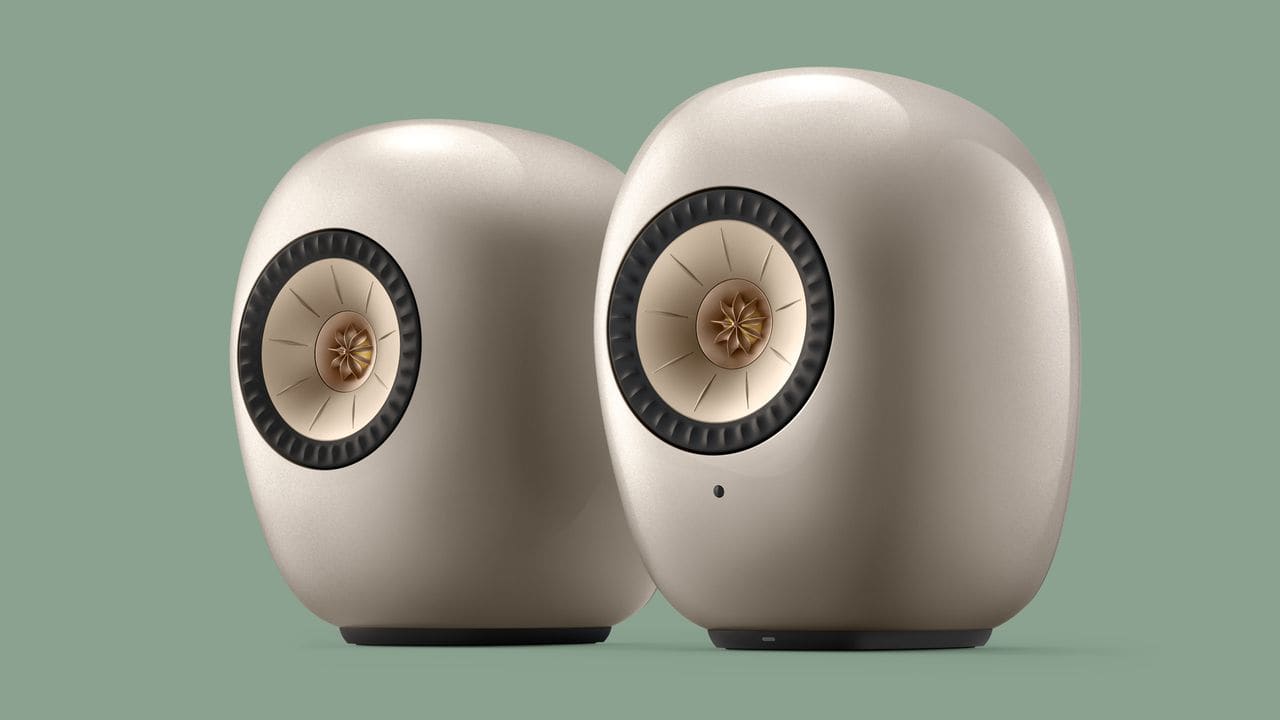
Walk into any design retailer today and you will encounter a landscape of right angles. Speakers, in particular, have settled into a visual consensus: black monoliths, walnut veneer boxes, matte rectangles that telegraph seriousness through restraint. Against this backdrop, the LS Luxe feels almost defiant. KEF has partnered with Ross Lovegrove to deliver a compact wireless speaker whose enclosure refuses the orthogonal grid entirely, opting instead for a fluid, sculptural presence that recalls an earlier moment in product design when biology, not geometry, provided the formal vocabulary.
Lovegrove's involvement is not new to KEF. The designer previously worked with the British manufacturer on the Mu headphones and Muo portable speaker, establishing a working relationship that clearly values his neo-organic approach. Founded in 1961 as Kent Engineering and Foundry, KEF has a history of engaging industrial designers to shape its hardware, including the late Terence Conran. The LS Luxe extends this lineage, but it does so at a moment when the pendulum has swung decisively toward minimalism's harder edges. The question the speaker implicitly asks is whether the curve still has cultural and aesthetic currency, or whether it will read as nostalgia for the iMac G3 era.
Form as Spatial Strategy
At the heart of the LS Luxe sits a 6.5-inch driver, a modest dimension that belies the speaker's ambition. What distinguishes the enclosure is its surfacing: smooth, continuous, and free of the faceting that typically results from cost-driven manufacturing. Lovegrove's design language has always leaned toward what he calls "organic essentialism," a belief that forms should emerge from function while still referencing natural structures. Here, the enclosure's curves are not arbitrary; they suggest fluidity and movement, qualities that align with KEF's positioning of the product as a luxury object meant to inhabit space rather than disappear into it.
KEF is explicit about this spatial ambition. Grace Lo, the company's president and head of global marketing, frames the LS Luxe as an answer to the question of what luxury sounds like, emphasizing transformation of atmosphere over mere technical performance. The wireless capability is central to this strategy. Freed from the need to sit near an amplifier or source component, the speakers can be placed as sculptural elements, their forms contributing to the room's visual composition rather than being dictated by cable runs and equipment racks.
Material and Palette
The LS Luxe is offered in three finishes: Dusk Titanium, Eclipse Black, and Mineral White. Each is chosen to accentuate the enclosure's continuous surfacing, avoiding the visual breaks that would result from contrasting materials or textures. The naming convention itself signals intent, borrowing from the vocabulary of luxury goods rather than consumer electronics. These are not "matte black" or "white"; they are "Eclipse" and "Mineral," terms that carry connotations of rarity and refinement.
Optional S-Lixe floor stands extend the design language vertically, incorporating cable management to preserve the clean lines. The stands are not an afterthought; they are part of a holistic approach to how the speakers occupy space, reinforcing the idea that these are objects to be displayed rather than concealed.
Acoustic Architecture and Connectivity
Technically, each LS Luxe speaker houses a 100W Class AB amplifier and a 280W Class D current-drive amplifier. KEF's proprietary W2 Wireless Platform handles connectivity, integrating with major streaming services including Amazon Music, Tidal, Qobuz, and Deezer through the company's app. The speakers also support direct casting from proprietary streaming applications, and physical inputs accommodate turntables, CD players, gaming consoles, and televisions. A dedicated C3 Remote provides tactile control, a gesture toward users who prefer physical interfaces over screen-based navigation.
The amplification architecture reflects KEF's broader engineering philosophy: current-drive amplification is intended to reduce distortion and improve transient response, particularly in the low frequencies where cabinet resonance can muddy detail. The wireless implementation is less about convenience than it is about placement flexibility, enabling configurations that would be impractical with traditional cabling.
Precedent and Context
Lovegrove's work has always existed in dialogue with mid-century organicism, particularly the biomorphic experiments of designers like Luigi Colani and the sculptural aspirations of Eero Saarinen. But where those designers operated in an era when organic forms were genuinely novel, Lovegrove's contemporary practice must contend with the fact that the curve has cycled in and out of fashion multiple times. The late 1990s and early 2000s saw a proliferation of fluid forms in consumer electronics, driven in part by advances in injection molding and the cultural optimism of the dot-com era. That moment passed, replaced by the flat ontology of touchscreens and the minimalism of Dieter Rams revivalism.
The LS Luxe arrives, then, not as a continuation of an unbroken tradition but as a conscious revival. Whether this revival resonates will depend on how audiences interpret the formal language. Does the curve read as forward-looking, a rejection of minimalism's exhausted tropes? Or does it feel retrograde, a return to an aesthetic that has already had its moment? The answer likely depends on generational perspective and individual taste, but the fact that KEF is willing to pursue this direction suggests a belief that there is appetite for alternatives to the prevailing visual consensus.
Luxury as Editorial Position
KEF's framing of the LS Luxe as a luxury product is worth examining. The speakers are priced at £3,500 per pair, positioning them above mid-market offerings but below the stratospheric territory of ultra-high-end audio. At this price point, buyers are not simply purchasing transducers; they are making a statement about taste, about the role objects play in domestic space, and about their relationship to design history.
Luxury, in this context, is less about exclusivity through scarcity and more about editorial curation. The LS Luxe offers a specific point of view, one that privileges sculptural presence and formal expressiveness over the neutral backdrop aesthetic that dominates much of contemporary product design. It is a position that carries risk. Objects with strong formal identities can feel dated more quickly than neutral ones, and the curve, in particular, is vulnerable to being read as a period marker. But the alternative, endless iterations of black boxes, offers no position at all.
The Broader Trajectory
At World Archi Design, we have been tracking a gradual shift in product design, a quiet movement away from the flat minimalism that has defined the past decade. This shift is not yet a wholesale transformation; it manifests in isolated projects and specific categories rather than as a unified trend. But the signs are accumulating: a renewed interest in tactile surfaces, a willingness to embrace color, and, in cases like the LS Luxe, a return to sculptural form.
Whether this represents a genuine inflection point or merely a brief deviation remains to be seen. The LS Luxe, for its part, offers a clear alternative to the prevailing orthodoxy. It asks whether there is still room, in an age of screens and algorithmic playlists, for objects that insist on their own presence, that refuse to recede into the background. The answer, as with all design questions, will be determined not by theory but by how people choose to live with these objects, and whether the curve can once again feel like the future rather than an echo of the past.
Credit: KEF
Save this story. A free account keeps your reading list and the 07:00 email in one place.
CREATE FREE ACCOUNT →SIGN IN