When Geometry Lives in the Kitchen Cabinet
What if the most rigorous formal vocabulary in your home sat not in a design monograph but on a shelf beside the olive oil? Across the projects we've covered this year—from Milan to Melbourne—a cluster of studios has begun treating pasta as an architectural typology, extracting massing principles from penne and spatial rhythm from lasagne waves. The trend surfaced in April when a luxury tile manufacturer teased mosaic panels depicting macaroni in marinara, then discovered the joke had tapped a vein of genuine appetite. By summer, the gag had materialized into a Tailored To program offering limestone rigatoni inlays and marble butter-noodle mosaics. The underlying insight: strip away the culinary context and pasta reveals itself as pure cylindrical, helical, and corrugated form—geometry that happens to be edible.
Formal Precedent in Durum Wheat
Canadian Italian industrial designer Chris Fusaro began his investigation by assembling mezzi paccheri tubes into a functional strainer, recognizing that the pasta's uniform diameter and chamfered edges created a modular system as disciplined as any Bauhaus grid. He has since expanded the series to include bronze-cast bowls and trivets that mimic the mosaic texture of dry noodles, a verdigris-patina Farfalle Pendant, and the black Mezze Maniche Chair, whose seat is an aggregation of short tubular segments. The lost-wax casting process treats each noodle as a discrete unit—mass-produced forms elevated through material translation. Fusaro's method echoes the tectonic strategies of Carlo Scarpa, who likewise found poetry in repetition and joinery, though Scarpa's palette ran to Istrian stone rather than semolina.
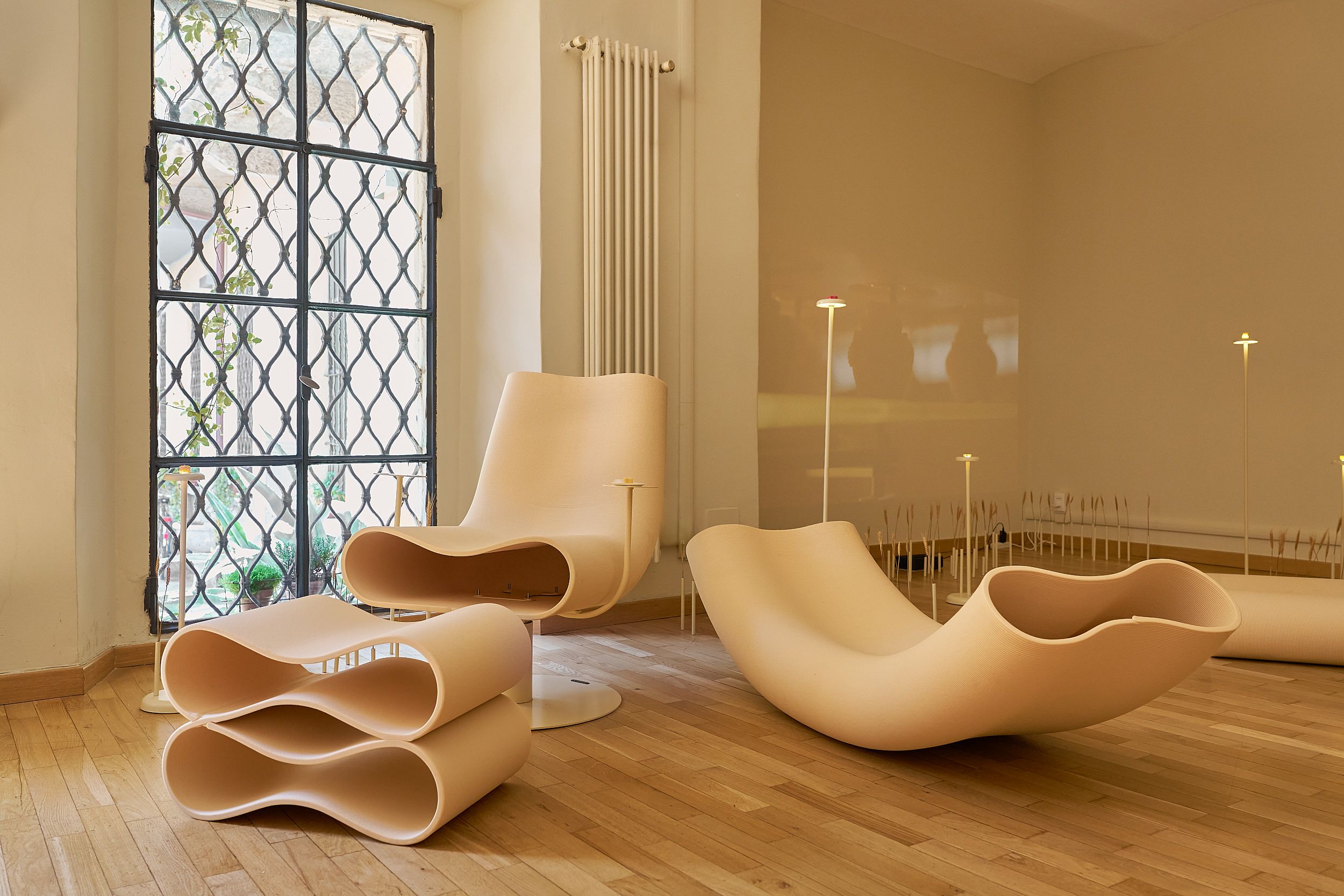
At this year's Salone del Mobile, Hong Kong– and Istanbul-based Studio Yellowdot collaborated with Artisia—a Barilla subsidiary specializing in 3D-printed dry pasta—to present Edible Reveries, an installation pairing chef-prepared tastings with a lounge seat, rocking chair, and ottoman printed in wood composite. Dilara Kan Hon, who co-founded the studio with her husband Bodin Hon, describes the extrusion process in culinary terms: the wood-fiber filament emerges from the nozzle warm and pliable, allowing real-time shaping before it cures. The resulting pieces enlarge the contours of lasagne ruffles and rigatoni ridges to furniture scale, translating the tactile softness of uncooked dough into load-bearing structures. A London designer who attended the exhibit noted that despite the visual suggestion of pliability, the cured composite felt stable underfoot—a perceptual dissonance that heightened the work's surrealism.
Domestic Hardware as Culinary Silhouette
Melbourne studio Lo & Co Interiors released its own Al Dente collection in late 2025, a suite of cabinet hardware that includes orecchiette knobs and the Lucia pull, whose profile mimics the undulating edge of a lasagne sheet. Tali Roth, the Melbourne designer who collaborated on the range, frames the appeal in haptic terms: consumers gravitate toward pieces that register as hand-shaped rather than CNC-milled, objects that carry the indexical trace of a maker's hand. Los Angeles interior designer Martha Mulholland specified the Lucia pulls for a client's ebonized credenza, valuing the hardware's irregular geometry and quiet humor—a counterpoint to the rectilinear discipline of mid-century cabinetry.
Arielle Lopresti, co-director of Lo & Co, argues that pasta motifs succeed because they occupy a liminal zone between familiarity and formal abstraction. The same ruffled edge that defines a lasagne noodle can be read as a vernacular reference or as a study in sinusoidal rhythm, depending on context. This duality allows the hardware to function in both maximalist and minimal interiors without tipping into kitsch.
Material Translation and the Theater of Context
San Francisco designer Caleb Ferris encountered pasta's formal potential while wandering grocery aisles during pandemic lockdowns, struck by the breadth of mass-manufactured shapes—a library of geometries optimized for sauce retention and cooking time but equally legible as sculptural studies. His 2023 capsule collection included a lasagne chair upholstered in black satin, its seat back a series of vertical pleats that won the ICFF Editors Award for Seating. Ferris describes the work as an exercise in tonal shifts: the same ruffled silhouette that signifies comfort food in a kitchen becomes theatrical when rendered in luxury textile and elevated on a plinth.
New York interior designer Tara McCauley pursued a more literal route, constructing a table lamp whose shade is assembled from actual linguine noodles, garnished with faux parsley and mounted above a clamshell base. Presented at the 2025 Collectible Design Fair, the piece prompted a recurring cycle of confusion and delight as visitors realized the pasta was uncooked and structural. McCauley positions the lamp within a tradition of surrealist domestic objects—Man Ray's Gift iron, Meret Oppenheim's fur teacup—where everyday materials are recontextualized to provoke cognitive friction. The humor, she notes, is crucial: pasta-inspired design succeeds when it acknowledges its own absurdity without collapsing into novelty.
Precedent and the Democratic Muse
The pasta trend invites comparison to earlier moments when designers mined vernacular forms for spatial ideas. Aldo Rossi's La Conica espresso maker translated the massing of Milanese church domes into tabletop scale; Achille Castiglioni's Mezzadro stool repurposed a tractor seat as domestic furniture. Both gestures operated through material inversion—sacred architecture rendered in steel, agricultural equipment upholstered in leather—much as Fusaro's bronze rigatoni elevates a commodity grain product into heirloom object. The difference lies in accessibility: pasta is a material language legible across geographies and class strata, a formal vocabulary that requires no specialized knowledge to decode.
Teegan Cocchiaro, co-director of Lo & Co, frames pasta as "the most democratic form of artistry," a medium that carries personal and collective memory without the institutional gatekeeping of high design. Every diner has an opinion on orecchiette versus penne; few can discourse on the fenestration strategies of Palladio. This democratic legibility may explain why pasta-inspired objects circulate so fluidly on social media—they reward both casual viewers and design literati, operating simultaneously as meme and as formal study.
The Appetite for Levity in Spatial Practice
At World Archi Design, we've been tracking a broader shift toward designs that refuse austerity in favor of narrative texture. The past decade's Scandinavian minimalism—white oak, linen, negative space—has ceded ground to maximalist interiors rich in pattern, color, and referential play. Pasta motifs align with this pivot: they introduce organic geometry and tactile variation without the earnestness of biophilic design or the high seriousness of parametric modeling. A rigatoni chair can sit comfortably beside a Prouvé daybed or a Gaetano Pesce resin table; its formal rigor is intact, but its cultural register is lower, more conversational.
Zach Epstein, president and chief product officer at the tile manufacturer behind the limestone macaroni mosaics, describes the pattern as "very useful, abstract"—a phrase that captures the trend's dual function. Stripped of sauce and plated context, pasta reads as modular geometry, a system of cylinders, spirals, and corrugations that can be arrayed in infinite combinations. The fact that it also evokes Sunday dinners and grandmother's kitchens adds narrative depth without compromising formal clarity.
Forward: Edible Typologies and the Expanding Pantry
If pasta can yield a coherent design language, what other culinary forms await translation? The 3D-printing technologies that enabled Studio Yellowdot's wood-composite noodles and Artisia's edible prototypes lower the barrier to material experimentation, allowing designers to test geometries in filament before committing to bronze or marble. We may soon see furniture derived from the helical structure of fusilli, lighting informed by the radiating arms of rotelle, or tile patterns extracted from the dimpled surface of gnocchi. The pantry, it turns out, is a typological archive—one that designers are only beginning to index.
What distinguishes this trend from mere novelty is its grounding in material rigor and spatial logic. Fusaro's bronze strainers and McCauley's linguine lamps succeed not because they reference food, but because they translate edible geometries into durable, functional objects with formal integrity. The humor is present—pasta is inherently comedic in its abundance of shapes—but it never overrides the tectonic ambition. As domestic interiors grow more eclectic and less rule-bound, pasta-inspired design offers a template for how vernacular forms can enter the canon without shedding their everyday resonance.
Save this story. A free account keeps your reading list and the 07:00 email in one place.
CREATE FREE ACCOUNT →SIGN IN